

Can Lymphedema Be Reversed or Only Managed?
When patients first receive a diagnosis of lymphedema, or when they first notice that persistent swelling in an arm or leg, the first question is almost always the same: "Will this go away?"
It is a simple question with a complex answer. In a medical landscape where we can replace hips, transplant hearts, and laser-correct vision, the idea of a chronic, lifelong swelling condition feels terrifying. Patients want a cure. They want to "fix" the plumbing and go back to normal.
The short answer is: Lymphedema currently has no cure.
However, that answer is incomplete and often unnecessarily discouraging. While the underlying damage to the lymphatic system cannot typically be "undone," the symptoms—the swelling, the heaviness, the risk of infection—can be dramatically reversed, especially if caught early.
The difference between "reversing the condition" and "reversing the symptoms" is critical. Understanding this distinction is the key to living a full, active life versus living in fear of your own body.
In this comprehensive guide, we will explore the reality of lymphedema progression, the science of what is actually happening in your tissues, and why early professional intervention at Lympha Villa can mean the difference between a minor nuisance and a major disability.
The Myth of "Cure" vs. The Reality of Management
To understand why lymphedema is generally considered chronic, we have to look at the mechanics of the lymphatic system.
If you break a bone, the body knits the bone back together. If you cut your skin, the body bridges the gap with new tissue. But the lymphatic system is different. When lymph nodes are surgically removed (as in cancer treatment) or destroyed by radiation, they do not grow back. The "pump station" is gone forever.
Similarly, in Primary Lymphedema, where vessels are malformed or missing from birth, the body does not spontaneously grow new ones to correct the genetic error.
Because the structural defect is permanent, the medical definition classifies lymphedema as an incurable, chronic condition.
But here is the good news: The human body is incredibly adaptable. While we cannot regrow lymph nodes, we can "retrain" the flow of fluid. We can use healthy lymphatic vessels in other parts of the body to pick up the slack.
So, while we cannot "reverse" the fact that you are missing lymph nodes, we can often reverse the swelling to the point where it is virtually undetectable. This is what we call "clinical reversal" or "maintenance phase."
The Window of Opportunity: Understanding the Stages
The answer to "Can it be reversed?" depends entirely on when you ask the question. Lymphedema is a progressive disease. It moves through four distinct stages. In the early stages, reversal is very possible. In the later stages, the goal shifts to management and reduction.
Stage 0: The Latent Stage (Reversible)
This is the "invisible" stage. The lymphatic system is damaged (e.g., lymph nodes have been removed), but the remaining vessels are working overtime to compensate.
Symptoms: There is no visible swelling. You might feel a sensation of heaviness, fullness, or "pins and needles."
Reversibility: Highly reversible. If you intervene here with education and occasional preventative therapy, you may never develop visible swelling.
Stage 1: Spontaneously Reversible (Reversible)
This is where fluid begins to accumulate, usually becoming visible by the end of the day.
Symptoms: Soft, puffy swelling. If you press your thumb into the skin, it leaves an indentation ("pitting").
Reversibility: The name says it all. The swelling often disappears completely ("reverses") with elevation or a night’s sleep. This is the critical window for treatment. With proper compression and Manual Lymphatic Drainage, we can often keep a patient in this stage indefinitely, effectively "reversing" the visible disease.
Stage 2: Spontaneously Irreversible (Managed)
At this point, the nature of the tissue changes. The protein-rich fluid has caused inflammation, leading to fibrosis (hardening).
Symptoms: The swelling does not go down with elevation. The tissue feels firmer. Pitting is difficult.
Reversibility: We can reduce the fluid volume significantly, but the scar tissue (fibrosis) is harder to reverse. The condition is now about management: wearing garments daily to maintain the reduction. You can get the limb close to normal size, but it requires constant effort.
Stage 3: Lymphostatic Elephantiasis (Managed/Palliative)
This is the most severe stage.
Symptoms: Extreme increase in volume, hardening of the skin (hyperkeratosis), papillomas (wart-like growths), and frequent infections.
Reversibility: Complete reversal to "normal" is usually not possible. However, massive reductions in size and dramatic improvements in quality of life are absolutely achievable with intensive therapy.
Why Can’t We Just "Drain" It Once?
Patients often ask, "Can’t you just drain the fluid and be done with it?"
It is a logical question. If you have water in your basement, you pump it out, and the basement is dry. But lymphedema is not like a flooded basement; it is like a basement with a broken pipe that is constantly leaking.
Your body produces lymph fluid 24 hours a day, 7 days a week. It is a biological constant. If your transport system (the lymph vessels) is running at 50% capacity, but your fluid production is at 100%, you will always have a surplus.
If we perform Manual Lymphatic Drainage (MLD) today, we clear the surplus. But tomorrow, your body will produce more fluid, and the surplus will return.
This is why reversal is a lifestyle, not a one-time event. "Reversing" lymphedema means creating a new daily routine that artificially supports the broken system so it can keep up with the load.
The Role of Fibrosis: The Enemy of Reversal
The biggest hurdle to reversing lymphedema is fibrosis.
Lymph fluid is protein-rich. When it sits in the tissue for too long (Stage 2 and beyond), it acts as a chronic irritant. The body reacts to this inflammation by laying down collagen fibers—essentially scar tissue.
This turns the fluid from a liquid state (which is easy to move) into a semi-solid or solid state (which is very hard to move).
Early Intervention: If we treat the swelling while it is still liquid (Stage 1), we can drain it easily.
Late Intervention: If we wait until the tissue becomes fibrotic, we first have to soften and break down the hardened tissue before we can drain the fluid.
This underscores the vital importance of seeking professional care at the very first sign of swelling. Waiting "to see if it goes away" allows fibrosis to set in, making reversal significantly harder.
Can Surgery Reverse Lymphedema?
In recent years, microsurgery has offered new hope for "reversing" the physiological defects of lymphedema. While these are promising, they are rarely "cures" in the traditional sense and often still require lifelong management.
Lymphovenous Bypass (LVA): Surgeons connect a blocked lymphatic vessel directly to a nearby vein, creating a "detour" for the fluid to drain into the blood. This is most effective in early stages where the vessels are still healthy.
Vascularized Lymph Node Transfer (VLNT): Surgeons take healthy lymph nodes from one part of the body (like the groin) and transplant them to the affected area (like the armpit). The hope is that these new nodes will sprout new vessels.
Even after successful surgery, most patients must still wear compression garments and receive manual therapy to maintain the results. Surgery is another tool for management, not a magic eraser.
The "Gold Standard" for Reversal & Management
Whether your goal is to reverse early symptoms or manage a chronic condition, the path is the same. It is called Complete Decongestive Therapy (CDT).
At Lympha Villa, we implement this two-phase protocol to give you the best possible outcome.
Phase 1: The Reduction Phase (Reversal)
The goal here is to mobilize the accumulated fluid and reduce the size of the limb as much as possible. This is the "active reversal" phase.
Daily Manual Lymphatic Drainage: We manually pump the fluid toward healthy lymph nodes.
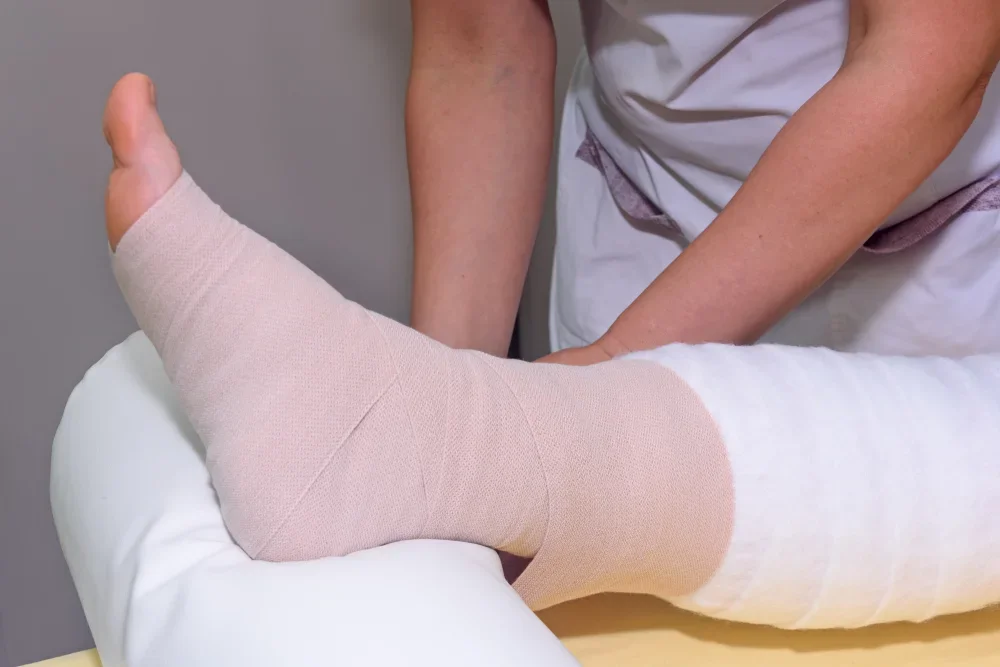
Compression Bandaging: You wear multi-layer bandages 23 hours a day. These bandages have low elasticity, creating a rigid wall that forces fluid out when you move.
Skin Care & Exercise: Protecting the skin and activating the muscle pumps.
This phase typically lasts 2-4 weeks, depending on the severity. It continues until the limb stops shrinking.
Phase 2: The Maintenance Phase (Management)
Once the limb is as small as it can get (reversal is maximized), we switch to keeping it that way.
Compression Garments: Wearing elastic sleeves or stockings during the day.
Self-MLD: We teach you how to perform a simplified version of drainage on yourself.
Periodic "Tune-Ups": Coming in for professional sessions when the limb feels heavy or after travel.
This phase lasts for life. It is the "new normal" that keeps the condition reversed.
Why Professional Care is Non-Negotiable
Trying to reverse lymphedema on your own is dangerous.
Diuretics (Water Pills): Many patients try to take water pills to reduce swelling. This removes water from the blood but leaves the protein in the tissue, which actually makes the fibrosis worse and the swelling harder to treat later.
Improper Compression: Buying an over-the-counter compression sleeve that fits poorly can create a tourniquet effect, trapping fluid in the hand or foot and causing new damage.
Aggressive Massage: Deep tissue massage can collapse fragile lymphatic vessels.
You need a Certified Lymphedema Therapist (CLT) who understands the anatomy. At Lympha Villa, we map your unique drainage pathways. If your right armpit is blocked, we don't just push fluid up the arm; we push it across the chest to the left armpit or down to the groin. We find the detours that allow for effective drainage.
Ready to start your reduction journey? Check our availability here: Book a Session.
Psychological Reversal: Taking Back Control
There is another aspect of reversal that is rarely discussed: the psychological shift.
Lymphedema can make you feel like a victim of your body. It can feel uncontrollable and unpredictable.
"Reversing" lymphedema is also about reversing that mindset. When you enter treatment, you learn exactly how your system works. You learn how to wrap your arm, how to massage your neck to clear the terminus, and which exercises help pump fluid.
You transition from being a patient who suffers from swelling to an expert who manages their physiology. You regain control. You learn that you can travel, exercise, and live fully, provided you respect the rules of your lymphatic system.
Practical Steps to Maximize Reversal
If you want to get as close to "reversal" as possible, follow these pillars of lymphatic health:
Weight Management: Obesity places significant pressure on the lymphatic vessels. Studies show that weight loss can drastically reduce lymphedema volume, sometimes making it negligible.
Early Detection: If you have had cancer surgery, ask for a baseline measurement of your limbs. If you notice even a 1-2cm difference, seek help immediately.
Consistency: Wearing your compression garment is annoying. But wearing it is the only thing stopping gravity from filling your limb with fluid again. Consistency is the secret to reversal.
Nighttime Care: For many patients, wearing a nighttime compression garment is the game-changer that keeps swelling down while they sleep.
Conclusion: A New Definition of Healing
So, can lymphedema be reversed?
If you mean "cured once and for all," the answer is generally no.
If you mean "can the swelling be reduced to near-normal size and kept there," the answer is a resounding YES.
Do not let the label "chronic" discourage you. Diabetes is chronic. Hypertension is chronic. Millions of people live healthy, active lives with these conditions by managing them. Lymphedema is no different.
With the right therapy team, the right education, and a commitment to your own health, you can keep lymphedema in the background of your life, rather than the forefront.
Don't accept "swollen" as your permanent reality.
Whether you are in Stage 0 or Stage 3, improvement is always possible. We have seen limbs reduce dramatically in size, restoring function and hope to our patients.
Explore our specialized therapies: Lympha Villa Services
Let’s start your reduction plan today: Book Your Session
Your lymphatic system may be compromised, but your life doesn't have to be.